


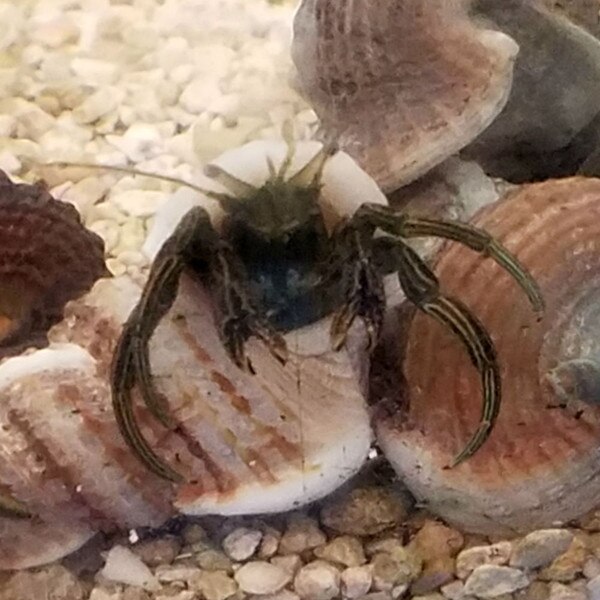
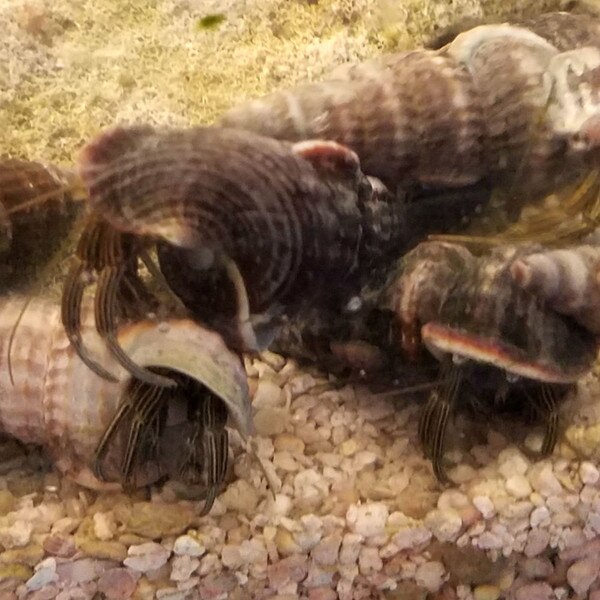
Thinstripe Hermit Crab - Clibanarius vittatus
RETAIL STORE ONLY, not available for shipping. Call to confirm availability and price.
Details
Mix and Match to save! Quantity discount applies to all eligible saltwater hermit crabs and shrimp on your order.
Most hermit crabs are scavengers. Some smaller hermit crabs will feed on algaes like nuisance hair algae while larger hermit crabs are scavengers and carnivores. Most hermit crabs are opportunistic - they will not actively hunt for a fish or active invertebrates but will prey on sick, dead, or dying individuals. Only the larger hermits like those from the genuses Aniculus, Dardanus, Paguristes, and Petrochirus are a real threat to healthy, larger tankmates or to corals. Calcinus, Clibanarius, and Paguristes are some of the most common "clean-up crew" hermit crabs for algae control and to eat leftover foods and detritus. Hermit crabs that are underfed are also a greater threat to tankmates like snails and other invertebrates.
Hermit Crabs have soft abdomens and use empty snail shells to protect their bodies. As with other crustaceans, hermit crabs must molt to grow. When they molt, they crawl out of their shell homes and shed their own hard shell to grow larger. As they grow larger, they need to find new, larger shells in which to live. Provide extra larger shells in the aquarium for the hermit crabs to move into. Hermit crabs without homes may sometimes make their own by killing the snail inside, or they may molt before they have a new shell, leaving them extremely vulnerable to predators.
Crustaceans benefit from iodine and mineral supplements to help form a healthy, hard exoskeleton. Regular water changes with high quality salt mixes usually provide enough, but extra supplements may be needed in reef tanks or in tanks with heavy invertebrates loads that use up iodine and other minerals rapidly. If water changes with new, fresh saltwater are not done regularly, the minerals also get depleted and nitrates accumulate and can also be detrimental to crustaceans and other invertebrates.
Specifications
| Specifications | |
| MPN | 0114-hermit |
| Manufacturer | That Fish Place |
| Common Name | Thinstripe Hermit Crab |
| Scientific Name | Clibanarius vittatus |
| Reef Safe | Yes, with caution |
| Invert Safe | Yes, with caution |
| Community Safe | Yes, with caution |
| Difficulty | Easy |
| pH Range | 8.0-8.4 |
| Temperature Range | 75-82 |
| Specific Gravity Range | 1.022-1.026 |
| Diet | Omnivore, Scavenger |
| Internal Id | 46126 |
| State Restrictions |
| Alaska |
| Armed Forces Americas |
| Armed Forces Europe |
| Armed Forces Pacific |
| California |
| Hawaii |
| Puerto Rico |